So, what exactly is the difference? And more importantly, which one should your business focus on in 2026? The short answer is: both. But understanding how they work together (and where they differ) is key to staying competitive.
In this guide, we’ll break down GEO vs SEO clearly and practically — no fluff, just actionable insights you can actually use.
Summary GEO vs SEO
| Factor | SEO | GEO |
|---|---|---|
| Goal | Rank in search engine results (SERPs) | Appear in AI-generated answers |
| Audience | Search engine algorithms | Large Language Models (LLMs) |
| Output | Blue links on a SERP | Citations in AI responses |
| Key Signals | Backlinks, keywords, technical factors | Authority, clarity, structured content |
| Measurability | Rankings, traffic, CTR | Brand mentions in AI (emerging) |
| Content Style | Keyword-rich, optimized for crawlers | Authoritative, clear, answer-focused |
| Maturity | Mature, well-established | Emerging, rapidly evolving |
What Is SEO? A Quick Refresher
Search Engine Optimization (SEO) is the practice of improving your website so it ranks higher in traditional search engine results pages (SERPs) — primarily on Google, Bing, or Yahoo.
When someone types a query into Google, the search engine crawls billions of pages, evaluates them against hundreds of ranking signals, and delivers a list of results. SEO is the art and science of making sure your content shows up near the top of that list.
The core pillars of SEO include:
- On-page SEO: Keyword optimization, content quality, meta tags, and internal linking.
- Technical SEO: Site speed, mobile-friendliness, crawlability, and structured data.
- Off-page SEO: Backlinks, brand mentions, and domain authority.
- Local SEO: Optimizing for location-based searches like “Power Apps consultants near me.”
SEO has been the backbone of digital marketing for years — and it’s not going anywhere. But the landscape is evolving fast.
What Is GEO? Understanding Generative Engine Optimization
Generative Engine Optimization (GEO) is a newer discipline focused on optimizing your content so it gets cited, referenced, or included in responses generated by AI-powered tools like ChatGPT, Google’s AI Overviews, Bing Copilot, Perplexity AI, and similar platforms.
When a user asks an AI assistant “What’s the best low-code platform for business apps?” — the AI doesn’t show a ranked list of links. Instead, it synthesizes information from multiple sources and delivers a direct answer. GEO is about making sure your business is one of those sources.
Think of it this way: SEO gets you onto Google’s first page. GEO gets you inside the AI’s answer.
Why GEO Matters Right Now
AI-generated answers are already eating into traditional search click-through rates. Studies in early 2025 found that AI Overviews in Google reduce organic clicks for many informational queries. Users who get their answer directly from an AI snippet often don’t click through to any website at all.
This is a massive shift. And it means businesses that only optimize for traditional SEO may start to see their traffic erode — even if their rankings stay the same.
GEO vs SEO: Key Differences at a Glance
| Aspect | Traditional focus | GEO focus in 2026 |
|---|---|---|
| Primary goal | Visibility in classic lists | Visibility inside AI answers and Overviews |
| Optimization unit | Page and keyword | Entity, question, and answer block |
| Measurement | Clicks and average position | Citations, mentions, assistant referrals, and assisted conversions |
| Content style | Long narratives and keyword variations | Clear Q&A segments, structured examples, and concise explanations |
How SEO and GEO Actually Overlap
Here’s the good news: a strong SEO foundation directly supports your GEO strategy. AI models are trained on web content, and they tend to favor sources that already demonstrate authority, relevance, and trustworthiness — which are the same things Google rewards.
Specifically, these SEO practices also benefit GEO:
- High-quality, in-depth content: AI models prefer comprehensive answers. Long-form, well-structured content that genuinely helps users tends to get cited more.
- E-E-A-T signals: Experience, Expertise, Authority, and Trustworthiness matter hugely for both Google and AI systems. Publishing content from real experts, citing sources, and maintaining an active online presence all help.
- Structured data and schema markup: Makes your content easier for both search engines and AI crawlers to interpret correctly.
- Backlinks from authoritative domains: Signals credibility to both Google and, indirectly, to the LLMs trained on the web.
So if you’ve been doing SEO well, you’re already partway to being GEO-ready. The key is to take a few additional deliberate steps.
GEO-Specific Strategies: What’s Different
While SEO and GEO share common ground, GEO requires some unique approaches. Here’s what to focus on:
1. Write Definitive, Answer-First Content
AI models are looking for content that clearly answers questions. Start every major section with a direct, concise answer — then expand. This is sometimes called the “inverted pyramid” style. For example, if your article is about Power Apps licensing, the first sentence should define what it costs, not build up to it slowly.
2. Build Brand Mentions Across the Web
AI models don’t just look at your website. They scan the entire web. If your brand, your team, or your content is mentioned on industry publications, forums, LinkedIn, YouTube, and other authoritative platforms — you’re more likely to be cited in AI answers. Think of it as digital PR for AI.
3. Create Content That AI Can Easily Quote
Structure your content with clear, quotable statements. Use short, punchy paragraphs for key definitions. Use tables, bullet points, and numbered lists. Avoid vague language — AI models prefer precise, factual content they can reproduce accurately.
4. Optimize for Topical Authority, Not Just Keywords
AI systems favor sources that cover a topic comprehensively. If your website has 15 well-written articles about Power Apps — covering everything from beginner tutorials to advanced integrations — you’re much more likely to be treated as an authority on that topic by both Google and AI tools.
5. Keep Content Fresh and Accurate
Outdated information gets filtered out by both search engines and AI models. Update your articles regularly. Add “Last Updated” dates. Cite current data. This signals reliability — a critical factor for GEO.
The Role of Technical SEO in a GEO Strategy
Don’t neglect the technical side when thinking about GEO. AI crawlers and search engine bots share many similarities — both need to access, read, and understand your content efficiently.
Key technical factors that support both SEO and GEO:
- Fast page load speed: Slow sites get penalized by Google and are less likely to be fully crawled.
- Clean site architecture: Logical URL structures, clear navigation, and XML sitemaps all help.
- Schema markup: FAQ schema, HowTo schema, and Article schema help AI tools parse and reuse your content.
- HTTPS: A basic trust signal that both users and crawlers expect.
- Mobile optimization: Most AI and voice searches happen on mobile — your site must work perfectly on small screens.
If your website is built on WordPress, most of these technical elements can be handled with the right plugins and hosting configuration. A well-built site is the foundation of every successful SEO and GEO strategy.
Content Strategy for GEO vs SEO: What Should You Publish?
Your content calendar needs to serve both goals. Here’s a practical framework:
For SEO-focused content:
- Target specific, high-volume keywords with clear search intent.
- Use tools like Google Search Console, Ahrefs, or SEMrush to find gaps.
- Focus on ranking for “bottom of funnel” queries — people ready to take action.
- Optimize meta titles, descriptions, and URL slugs with your target keywords.
For GEO-focused content:
- Write comprehensive guides that cover a topic end-to-end.
- Answer the “People Also Ask” questions on Google — these mirror what AI models are asked.
- Publish case studies, tutorials, and data-driven articles that AI tools love to cite.
- Create content that establishes your team as genuine experts — author bios, credentials, and real-world examples matter.
The sweet spot? Content that does both. A well-optimized pillar article targeting “Power Apps examples for business” can rank on Google and be cited by AI tools when users ask ChatGPT for app ideas. That’s what Hako IT has been building — and it’s exactly the right approach.

Measuring Success: SEO Metrics vs GEO Metrics
One area where GEO and SEO diverge significantly is measurement. SEO has a mature set of KPIs:
- Keyword rankings
- Organic traffic
- Click-through rate (CTR)
- Bounce rate and dwell time
- Domain Authority / Domain Rating
- Conversions from organic traffic
GEO measurement is still evolving, but early frameworks include:
- Brand mention tracking in AI outputs: Tools like Brandwatch or manual prompt testing in ChatGPT/Gemini.
- AI citation monitoring: Checking whether your content is referenced when asking AI tools questions in your niche.
- Share of voice in AI answers: How often your brand appears compared to competitors in AI-generated responses.
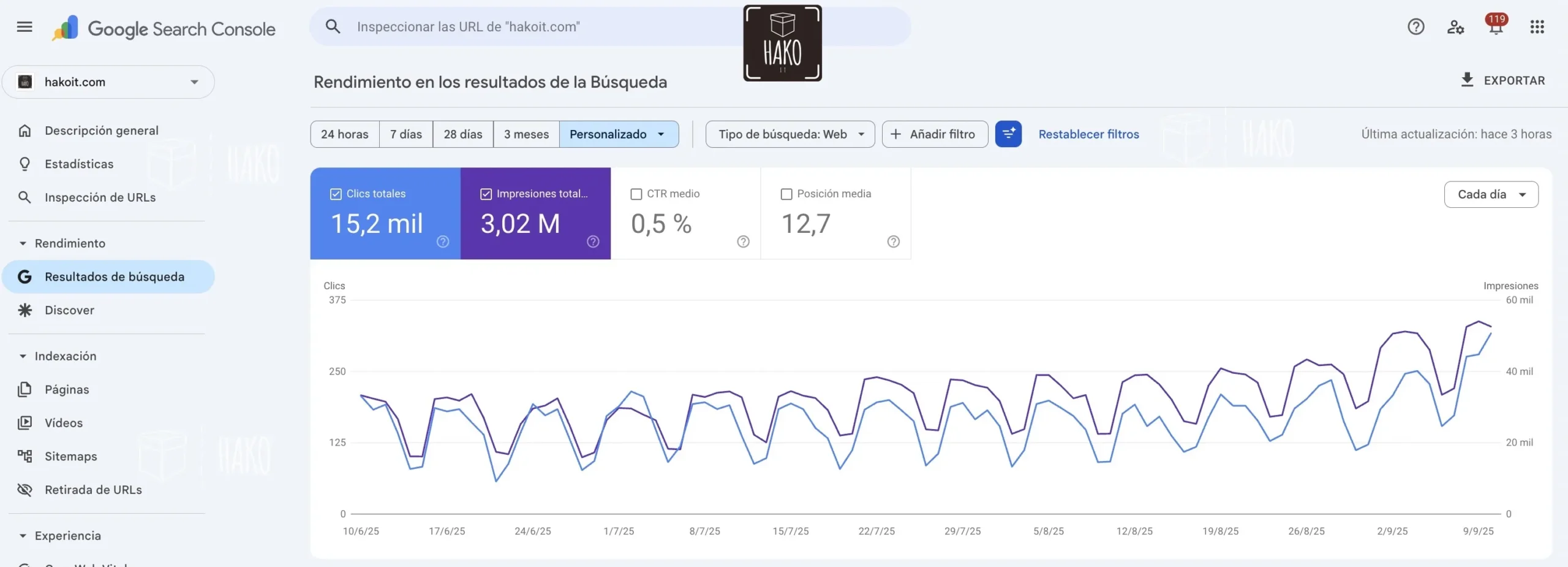
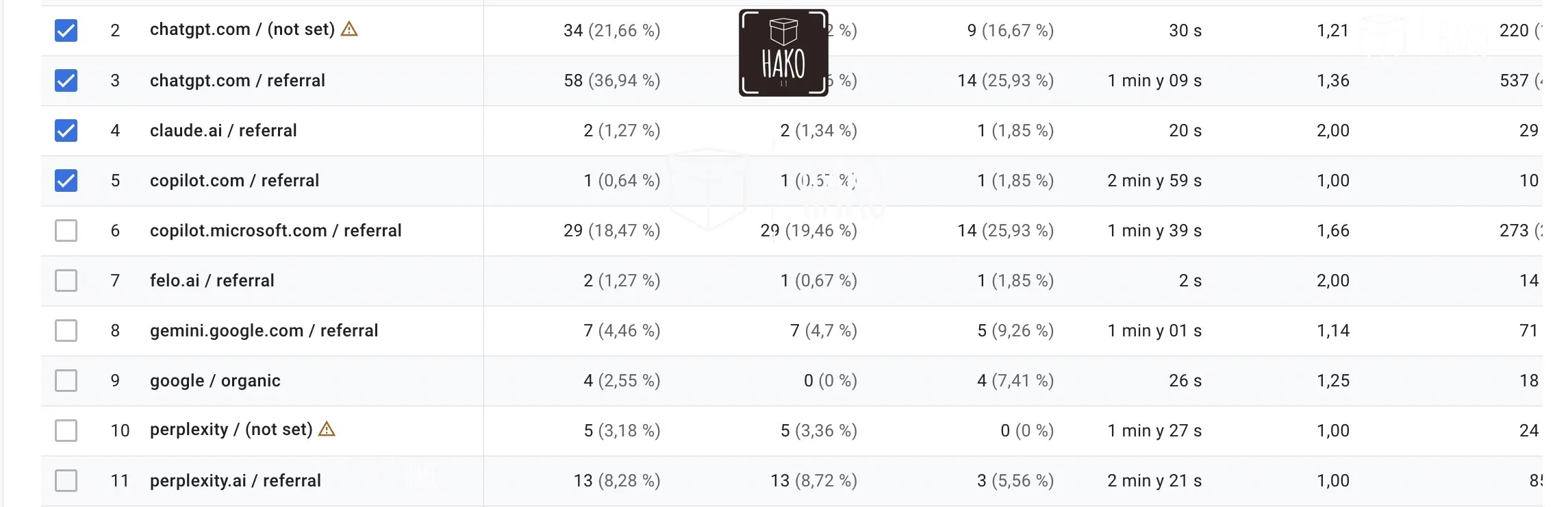
- Referral traffic from AI platforms: Some AI tools (like Perplexity) do send traffic — track this in Google Analytics.
It’s not yet as precise as SEO tracking, but this space is developing quickly. Start tracking now so you have baseline data as the tools improve.
Is GEO Replacing SEO? The Honest Answer
No — at least not yet, and probably not entirely. Here’s the reality:
Traditional search still drives enormous traffic. Billions of searches happen on Google every single day. SEO remains one of the highest-ROI digital marketing channels available. Ignoring it in favor of GEO would be a serious mistake.
But the trend is clear. AI-powered search is growing rapidly. Google’s own AI Overviews are appearing on more and more queries. Younger users, in particular, are increasingly turning to AI chatbots as their first point of search — not Google.
The smart move is to treat GEO as an extension of your SEO strategy, not a replacement. Build the strong content foundation that SEO requires, then layer in the GEO-specific tactics that make your content AI-citation-ready.
Think of it like this: SEO gets you on the map. GEO makes sure the AI knows you’re worth mentioning.
🚀 Is your website ready for both SEO and GEO?
At Hako IT, we build WordPress websites optimized from day one for search engines and AI visibility. From technical SEO to content strategy — we handle it all.
GEO vs SEO for Small and Medium Businesses: Where to Start
If you’re a small or medium-sized business, you might be wondering: do I really need to worry about GEO right now? The answer is yes — but strategically.
Here’s a realistic roadmap:
- First 3 months: Get your SEO foundation right. Fix technical issues. Publish 4-6 high-quality, keyword-targeted articles per month. Build internal links. Make sure your site is fast and mobile-friendly.
- Months 3-6: Start thinking about topical authority. Identify the 5-10 topics most relevant to your business and build a content cluster around each one. This helps both SEO rankings and AI citations.
- Months 6-12: Layer in GEO tactics. Optimize your best-performing content for AI citability. Add FAQ sections with direct answers. Build brand mentions through PR, LinkedIn, and guest posts on industry sites.
- Ongoing: Monitor both traditional rankings and AI visibility. Update content regularly. Adapt as the AI landscape evolves.
The businesses that start this process today will have a significant head start over those who wait until AI search becomes the dominant channel.
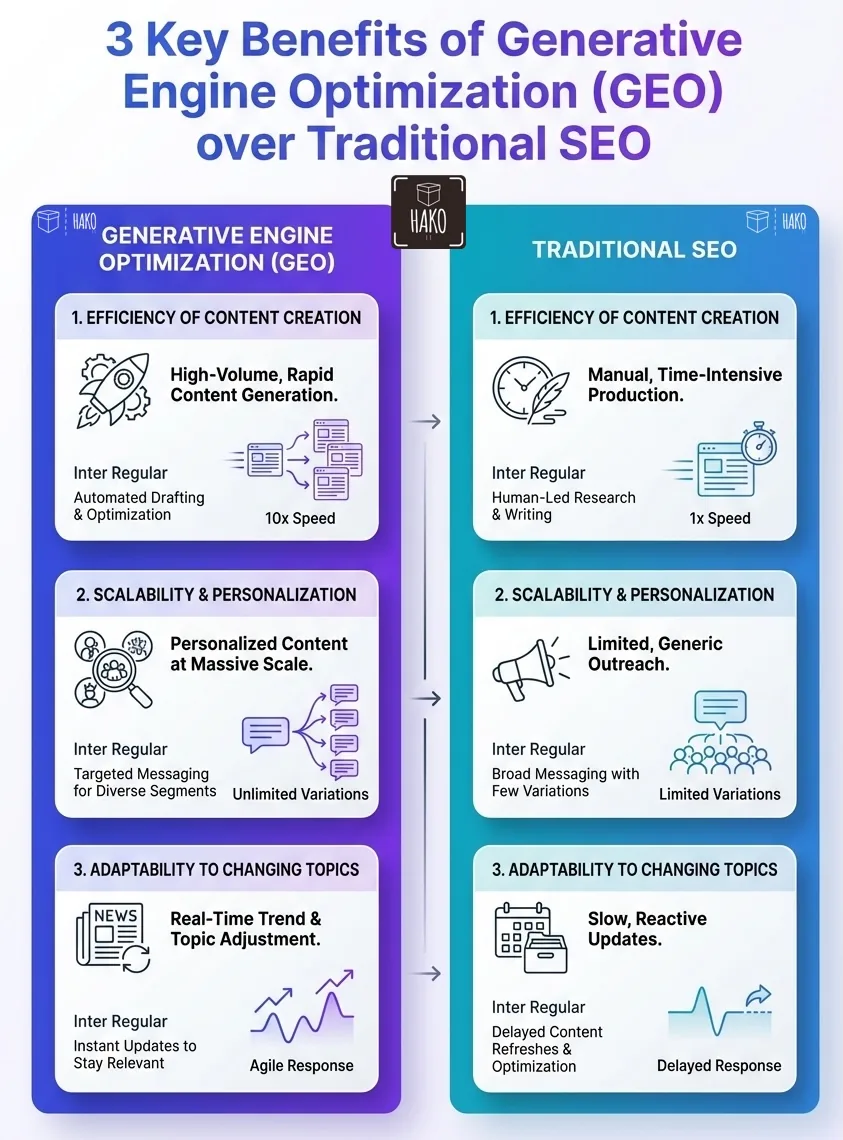
Three core benefits of Generative Engine Optimization (GEO) over traditional methods are highlighted here. Discover how GEO can improve efficiency, relevance, and results.
Real-World Example: How a Technology Company Can Win at GEO vs SEO
Let’s make this concrete. Imagine a company that specializes in Power Apps development — building custom business applications for clients across industries.
SEO strategy: They publish detailed articles targeting keywords like “Power Apps examples for HR,” “how to build an inventory app in Power Apps,” and “Power Apps vs Power Automate.” Each article is well-structured, keyword-optimized, and internally linked. Over time, they build rankings for dozens of relevant queries.
GEO strategy: Those same articles are written with a clear, authoritative voice. They include FAQ sections. They cite Microsoft documentation. They explain concepts so clearly that when someone asks ChatGPT “what’s a good Power Apps use case for inventory management,” the AI is likely to reference or paraphrase content from that site.
The result? The company shows up both in Google’s organic results and in AI-generated answers. Double the visibility. Double the credibility. This is exactly the kind of integrated approach that forward-thinking teams like Hako IT are building for their clients today.
Common GEO vs SEO Mistakes to Avoid
As you build your strategy, watch out for these pitfalls:
- Ignoring GEO entirely: Assuming traditional SEO is enough. It’s not — especially for informational queries where AI Overviews are taking over.
- Chasing AI citations without SEO basics: GEO doesn’t work in isolation. AI models cite content that Google and other search engines already trust.
- Publishing thin content: Both Google and AI systems penalize low-quality, shallow content. Depth and accuracy matter more than ever.
- Not updating old content: Stale articles hurt both SEO rankings and GEO citability. Schedule regular content audits.
- Ignoring structured data: FAQ schema, Article schema, and HowTo schema help AI tools parse and cite your content more effectively.
- Writing only for algorithms: The best content is written for people first. Content that genuinely helps readers is the content that ranks and gets cited.
The Future of GEO and SEO: What’s Coming in 2026 and Beyond
The convergence of AI and search is only accelerating. Here’s what to expect:
More AI Overviews: Google will continue rolling out AI-generated summaries for more query types. Informational, navigational, and increasingly transactional queries will all see AI involvement.
New AI search platforms: Tools like Perplexity AI, SearchGPT, and others are gaining real traction — especially among tech-savvy users. These platforms are fully GEO-dependent, with no traditional link listings at all.
Multimodal search: AI search is going beyond text. Images, voice, and video will all feed into AI-generated answers. Optimizing across formats will become important.
Smarter measurement: Platforms will develop better tools for tracking AI visibility, making GEO measurable in ways similar to SEO today.
Content quality bar rises: As AI becomes better at identifying and rejecting thin or low-quality content, the bar for what earns visibility — in both SEO and GEO — will continue to rise.
The businesses investing in high-quality, expert-driven, well-structured content right now are building an asset that will pay dividends across both channels for years to come.
📊 Want a website that ranks on Google AND gets cited by AI tools?
Hako IT designs and develops WordPress sites built for modern search — combining technical SEO excellence with content strategies designed for GEO visibility.
Frequently Asked Questions About GEO vs SEO
What does GEO stand for in digital marketing?
GEO stands for Generative Engine Optimization. It refers to the practice of optimizing your content so it appears in, or is cited by, AI-generated responses from tools like ChatGPT, Google AI Overviews, Bing Copilot, and Perplexity AI.
Is GEO the same as local SEO?
No. Despite the similarity in name, GEO (Generative Engine Optimization) is completely different from local SEO. Local SEO focuses on ranking for geographically specific searches (like “web developer in Madrid”). GEO focuses on appearing in AI-generated answers, regardless of location.
Do I need to stop doing SEO to focus on GEO?
Absolutely not. SEO and GEO complement each other. A strong SEO foundation — high-quality content, technical health, and authority signals — directly supports your GEO strategy. The best approach is to do both simultaneously, with a unified content strategy.
How do I know if my content is being cited by AI tools?
Currently, the most practical method is manual testing — ask ChatGPT, Perplexity, Gemini, or Bing Copilot questions related to your niche and see if your brand or content is referenced. Emerging tools are being developed to automate this monitoring.
Does GEO require a completely different content approach?
Not entirely. The core principles — accuracy, clarity, depth, and authority — are the same. GEO does require more attention to answer-first formatting, FAQ sections, structured data, and building brand mentions across the web. Think of it as an evolution of your existing content strategy, not a revolution.
How long does it take to see results from GEO?
GEO timelines are harder to predict than SEO, since AI models update at their own pace. Generally, building topical authority and earning brand mentions is a 6-12 month process. However, well-structured, authoritative content can start appearing in AI citations much faster — sometimes within weeks of publication, if the topic aligns with what AI tools are frequently asked.
Is GEO relevant for B2B companies?
Very much so. B2B buyers increasingly use AI tools for research before making purchasing decisions. If your company provides software solutions, consulting, or technology services, appearing in AI-generated answers when prospects ask about your category can directly drive leads and sales.
Conclusion: GEO vs SEO — A False Choice
The GEO vs SEO debate isn’t really a debate at all. These two strategies are more complementary than they are competing. In 2026, the businesses winning online are those that invest in content quality, technical excellence, and genuine authority — and then optimize that content for both traditional search engines and AI-powered platforms.
SEO gives you the foundation: rankings, traffic, and credibility. GEO gives you the future: visibility inside the AI answers that a growing share of your audience is relying on every day. Together, they form a complete, future-proof digital marketing strategy.
Whether you’re a startup building your first website or an established company looking to adapt to the AI-powered search era, the steps are the same: create genuinely helpful content, build authority, stay technically sharp — and keep learning as the landscape evolves.
At Hako IT, we help businesses navigate exactly this challenge — from building high-performance WordPress websites to developing Power Apps solutions and Power BI dashboards that make data work for you. Get in touch to find out how we can help your business grow in the era of AI-powered search.

👉 Contact us for more information or schedule a meeting.